

Brachial Plexus Stretch Injury
The brachial plexus is the bundle of nerves that runs from your neck into your arm, carrying movement and feeling all the way down to your fingers. A stretch injury happens when that bundle gets pulled tighter than it can take: the arm forced away from the neck and shoulder, or the shoulder pulled one way while the neck goes the other, until something in the bundle gives.
Most of the time this is mild: the nerve's outer coating is disrupted, the fibres underneath stay intact (called neurapraxia), and it heals on its own. A harder or longer pull can partially or fully tear the nerve fibres (a rupture), and the most severe version tears the nerve away from the spinal cord (an avulsion), which won't heal on its own and needs surgery.
In bondage, this comes from a sudden jerk or twist while an arm is under tension, or from an arm pulled far overhead or behind the body for a long stretch, during a suspension, an inversion, or a hard reposition mid-tie.
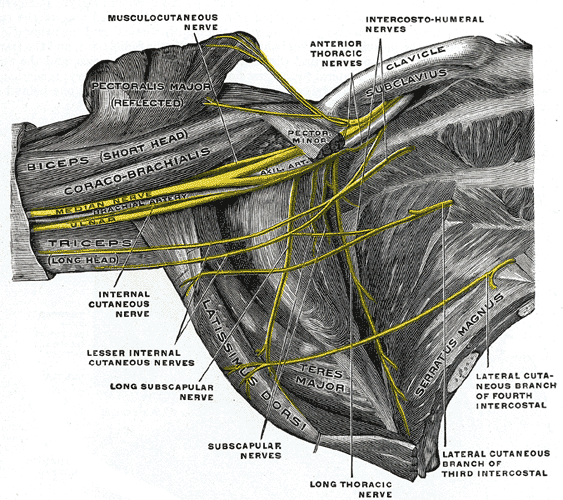
Tap image to enlarge.
COMMON NAMES
Stinger and burner are the informal names for the fast-onset version, most familiar from contact sports. Brachial plexopathy and traction plexopathy are the general clinical terms for the injury. Erb-Duchenne palsy refers specifically to the shoulder-and-elbow version, whether it appears in a newborn or an adult, and Klumpke's palsy to the rarer version that affects the hand instead.
WHAT TO LOOK FOR
The first sign is usually immediate: a sharp, burning or electric jolt starting at the neck or collarbone and running down the arm. It typically fades within a couple of minutes, which is exactly what makes it easy to write off.
Real damage can still be developing underneath that fast fade. Delayed onset is well documented in brachial plexus stretch research: weakness can resolve within minutes or take hours to days to develop. The one documented bondage case followed that same pattern, weakness didn't appear until several days after the injury.
It doesn't always look the same: trouble lifting the arm out to the side, raising it, or bending the elbow is one pattern; trouble with grip or finger movement, with the shoulder and elbow still working normally, is another.
Which pattern shows up points to where along the spine the affected nerves exit. Shoulder and elbow weakness points higher up, at the mid-neck (C5 and C6). Grip and finger weakness points lower down, near the base of the neck (C8 and T1).
WHAT IT SEPARATES FROM
Axillary nerve injury: A sharp jolt of pain directly on the shoulder, followed by numbness of the shoulder cap and the inability to lift the arm out to the side. The elbow remains fully mobile.
Nerve impingement further down the arm, radial, ulnar, or peroneal: compression rather than tension, and numbness in a specific patch of the hand or foot rather than weakness at the shoulder or elbow.
WHAT TO DO
Avoid sudden changes in angle once an arm is under tension. Reposition or invert slowly, with the rigger controlling the movement rather than the bottom's own weight snapping into a new position. Holding an extreme angle for a long time carries the same risk without any sudden movement.
A sudden jolt of pain means stop and release the arm immediately, don't push through to finish the position. Pain from the stretch usually fades within minutes on its own.
Ask them to raise the arm out to the side, bend the elbow, and grip something against light resistance, right after untying. Checking all three together also matters for telling this apart from a single nerve injury elsewhere in the arm: specific combinations of mobility, strength and pain point to different nerve injuries.
For a potential brachial plexus injury, check again the next day and then at regular intervals over the next week. The onset of symptoms may be delayed.
See a doctor if weakness affects both arms, spreads to grip or fingers, or hasn't started improving within about a week. Neurapraxia, the mild version, is usually clearly on the mend by then. A rupture or avulsion won't resolve on their own no matter how long you wait, and past that point you can't reliably tell which one you're dealing with without medical evaluation.
PREVALENCE & GENDER
A 2023 clinical case series on nerve injuries from Japanese rope bondage documented ten patients with sixteen compression injuries. The same authors separately reported one bottom who developed bilateral proximal weakness, unable to raise, lift, or bend either arm properly, after a sudden lateral jerk and body rotation during a suspension. No other bondage-specific numbers exist, and that likely reflects underreporting, not rarity: this case only surfaced because the patient was already part of a suspension-injury study, she recovered without seeking medical care. A milder stretch, or one not connected to a bondage session days later, would have even less reason to be reported.
Outside kink contexts, the same traction mechanism is well studied. An estimated 65% of American college football players report at least one stinger during their playing career, and around 70% of those go unreported at the time, since the pain fades so quickly it doesn't feel worth mentioning.
SURPRISING RESEARCH
The single most common way this exact injury happens, worldwide, isn't sport or bondage. It's childbirth: when a baby's shoulder catches during delivery and a clinician pulls to free it, the same stretch this entry describes happens to a newborn's neck and shoulder instead of an adult's. It's common enough that up to 20% of complicated deliveries result in a transient version, with roughly 10% of those cases leaving some lasting nerve damage.
HISTORY
British obstetrician William Smellie described the earliest known account: a case of transient bilateral arm paralysis in a newborn after a difficult labour, in his 1768 midwifery treatise. The connection to the nerve roots themselves wasn't made until nearly a century later.
Guillaume Duchenne made that connection first: analysing four infants with identical arm and shoulder paralysis, he coined the term obstetric palsy of the brachial plexus in 1861. Wilhelm Erb extended the same finding to adults in 1874, showing in his own thesis that the paired paralysis of the deltoid, biceps, and subscapularis traced back to a single lesion at the C5 and C6 nerve roots, the same junction named Erb's point after him, rather than several separate peripheral nerve injuries. That insight helped establish his later reputation as one of the founders of modern neurology, and the two names are paired today: Erb-Duchenne palsy describes the same upper-trunk pattern whether it appears in a newborn or an adult.
- The "Burner": A Common Nerve Injury in Contact Sports. American Family Physician, 1999. https://www.aafp.org/pubs/afp/issues/1999/1101/p2035.html
- Brachial Plexus Injury. Cleveland Clinic. https://my.clevelandclinic.org/health/diseases/22822-brachial-plexus-injury
- Brachial plexus injury. Wikipedia. https://en.wikipedia.org/wiki/Brachial_plexus_injury
- Erb's palsy. Wikipedia. https://en.wikipedia.org/wiki/Erb%27s_palsy
- Khodulev, V., Klimko, N., Charnenka, N., Zharko, M., & Khoduleva, K. (2023). Acute Radial Compressive Neuropathy: The Most Common Injury Induced by Japanese Rope Bondage. Cureus. https://pmc.ncbi.nlm.nih.gov/articles/PMC10294117/
- Shoulder Dystocia: Managing an Obstetric Emergency. American Family Physician, 2020. https://www.aafp.org/pubs/afp/issues/2020/0715/p84.html
- Gray, Henry. Anatomy of the Human Body, 20th ed. (1918), Plate 809, the right brachial plexus in the axillary fossa, viewed from below and in front (public domain). Wikimedia Commons. https://commons.wikimedia.org/wiki/File:Gray809.png