

Nerve Impingement
Nerve impingement is compression of a specific peripheral nerve, most commonly the radial, ulnar, or common peroneal (fibular) nerve in kink and everyday contexts, severe or sustained enough to disrupt that nerve's blood supply and its ability to conduct signal. It's an injury local to one nerve's pathway, arising wherever pressure sits directly over that nerve's specific route through the body, whether that's sustained pressure from rope or restraints, or the same nerve pathway taking repeated direct strikes over the course of an impact scene. Pressure at the wrong spot breaks down the myelin sheath around the nerve fibre at the point of compression, which is what actually blocks the signal. This is neurapraxia, and it recovers fully in the large majority of cases, though recovery can take anywhere from a few days to several months depending on severity.
COMMON NAMES
Nerve compression and nerve entrapment are used more or less interchangeably with nerve impingement, though entrapment more often describes a chronic anatomical condition (like carpal tunnel syndrome) than an acute positional injury. Saturday night palsy, honeymoon palsy, and squash palsy are informal names for the same mechanism affecting the radial nerve specifically, as are handcuff neuropathy and wristwatch neuropathy, named for two more everyday causes of the same compression. Neurapraxia is the clinical term for the mildest and by far most common form.
WHAT TO LOOK FOR
When it's happening, the affected nerve's own territory tends to follow a fairly consistent pattern: tingling or pins-and-needles first, then numbness, and if compression continues, weakness, a limp wrist, a dropped foot, fingers that won't close properly. Tingling and numbness on their own don't confirm nerve impingement is happening though, the same sensations show up from restricted blood flow or plain positional pressure on skin, with no nerve involved.
The way to tell nerve impingement apart in the moment is a physical check: press a thumbnail into each fingertip in turn, or the equivalent across toes, or lightly brush both hands and compare left to right. Uniform numbness across a whole limb isn't urgent on its own. One or two fingers or toes feeling different from the rest, or numbness on one side of a hand or foot but not the other, is what points to the nerve. Which fingers narrows it down further: the back of the hand and thumb side is the radial nerve, the pinky and half the ring finger is the ulnar nerve, the top of the foot or the gap between the first two toes is the peroneal.

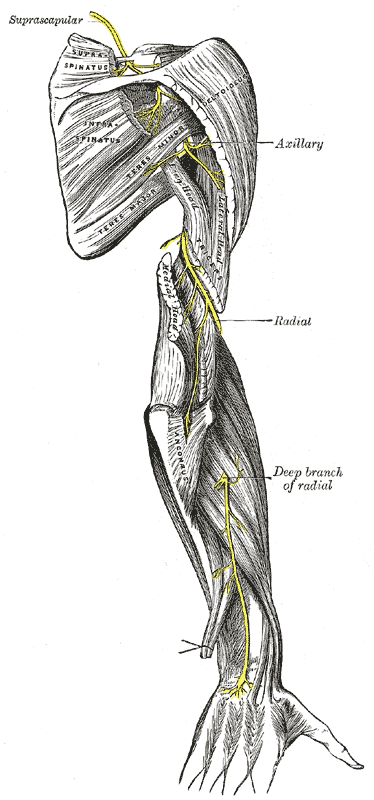
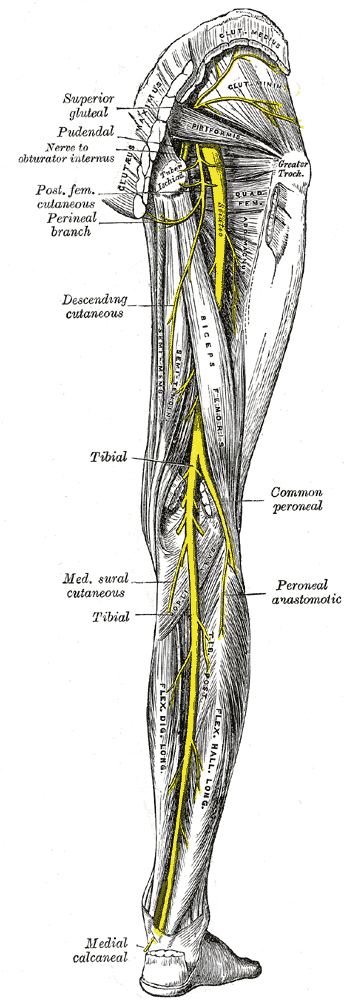

Tap any image to enlarge.
WHAT IT SEPARATES FROM
Circulation restriction: the two are frequently confused because both can produce numbness, but they're different risks with different urgency. Circulation loss affects a whole limb fairly uniformly, develops gradually, and is uncomfortable rather than urgent on its own. Nerve impingement is localised to one nerve's territory, can appear suddenly, and means stop immediately, not wait and see.
Axillary Nerve Injury: A sharp jolt of pain directly on the shoulder, followed by numbness of the shoulder cap and the inability to lift the arm out to the side. The elbow remains fully mobile.
Brachial Plexus Stretch Injury: A sharp jolt of pain that runs from the collarbone, over the shoulder and down into the arm. Upper roots: weak lifting and elbow bend, grip unaffected. Lower roots: weak grip, shoulder and elbow unaffected. Wrist function unaffected either way.
WHAT TO DO
Numbness removes the ability to notice it getting worse, so check on a schedule rather than waiting for a feeling to prompt it, a periodic physical check, not a mental check-in, is what actually catches this in time. In rope or restraint, that means checking at intervals throughout, not just once at the start. In impact play, it means not landing repeated strikes on the exact same spot without checking in on sensation there first. Don't rely on the bottom to prompt it either: subspace and general scene headspace blur time passing, a check that feels recent to them may have actually been a while ago. Checking is the top's job, on an actual clock, not a feeling either of you trusts in the moment.
Nerve checks aren't something anyone practices day to day, so knowing what different actually feels like isn't obvious in the moment. Ask them to describe sensation in the limb while unbound before ever binding anything, so there's a real baseline to compare against, and the first time either of you pay attention to this kind of comparison isn't mid-scene when it actually matters.
Asymmetric numbness, from the check above, means acting immediately, not waiting to see if it passes. In rope or restraint, reposition or unwrap rather than just loosening it slightly, the same spot compressed again picks up where it left off; if untying quickly isn't realistic, cut it, the nerve doesn't care how tidy the rope stays. In impact play, it means moving to a different target area or ending the scene, either is fine.
Weakness or lost motor control, a limp wrist, a dropped foot, fingers that won't close, means stop and release regardless, it means the injury has moved past sensory disruption into actual conduction failure.
Once released, rest the limb rather than immediately putting weight or pressure back on the same spot. Recovery is gradual, improving day to day is the expected pattern, and most cases resolve fully within two to three months. Symptoms getting worse instead of better, or weakness still present well past that window, means seeing a doctor rather than continuing to wait it out.
PREVALENCE & GENDER
The clearest available numbers come from a 2023 clinical case review of nerve injuries during full suspension bondage: 10 patients presented with 16 nerve injuries, and the radial nerve was involved in 90% of them. That data is suspension-specific because severe injuries are what reach a clinic and get studied, not because the risk itself is confined to suspension, the same compression mechanism happens in floor ties, cuffs, and any restrained position that holds sustained pressure on a limb. No population-level data exists for how often nerve impingement occurs across bondage practice more broadly. It's likely under-reported, since mild cases that resolve within minutes or hours often never reach clinical attention.
SURPRISING RESEARCH
The instrument for checking whether a nerve has actually lost sensation is sitting in plenty of toy drawers already: the spiked pinwheel sold for sensation play is the Wartenberg wheel, and it was popularised by the same neurologist who first described the exact injury this entry is about. Robert Wartenberg described compression of the superficial radial nerve from a tight wrist restraint in 1932, a condition informally called handcuff neuropathy and now known as Wartenberg syndrome. He wasn't even the first to find it: Schlesinger and Matzdorff had already reported a case caused by a wristwatch band back in 1926, Wartenberg's five-patient paper is just the one that made the name stick. He didn't invent the pinwheel either, it was already circulating in Germany, but he championed it and brought it into American neurology, calling it an indispensable part of the outfit for everyday practice. If there's one in the toy drawer, it's not just fitting to use for a nerve check, it's literally the instrument built for it.
HISTORY
The classification used today comes from Herbert Seddon, an orthopaedic surgeon who researched peripheral nerve injury at the Royal National Orthopaedic Hospital and later at Oxford, working alongside biologists J.Z. Young and Peter Medawar. Seddon described three tiers of nerve injury by severity and recovery prognosis, though the terms themselves, neurapraxia, axonotmesis, and neurotmesis, were coined by Lord Cohen of Birkenhead. Seddon published the classification in the journal Brain in 1943, and it was adopted internationally, still forming the basis of how nerve injuries are classified today.
The informal term for the mildest and most common version, temporary compression from sustained pressure rather than any deliberate injury, is Saturday night palsy: named for falling asleep with an arm hung over a chair armrest or the edge of a bed, compressing the radial nerve for hours. The same mechanism has other informal names depending on the cause: honeymoon palsy, when a partner's weight compresses the arm during sleep, and squash palsy, from the sport. None of these terms come from kink or clinical practice specifically, they describe the same everyday compression mechanism that shows up in rope, restraint, and prolonged positioning generally.
- Neurapraxia. Wikipedia. https://en.wikipedia.org/wiki/Neurapraxia
- Radial neuropathy. Wikipedia. https://en.wikipedia.org/wiki/Radial_neuropathy
- Nerve injury classification. Wikipedia. https://en.wikipedia.org/wiki/Nerve_injury_classification
- Herbert Seddon. Wikipedia. https://en.wikipedia.org/wiki/Herbert_Seddon
- Twisted Windows. Six Contributing Factors to Nerve Damage in Bondage. https://www.twistedwindows.com/bondagesafety/six-contributing-factors
- Helsinki Shibari. Nerve Safety for Rope Bondage. https://www.helsinkishibari.com/articles/nerve-safety-for-rope-bondage
- Shibari Studio Berlin. Rope Safety in Shibari: Nerves, Circulation and Warning Signs. https://www.shibari-studio.com/shibari-journal/shibari-safety-nerve-risk
- Khodulev, V., Klimko, N., Charnenka, N., Zharko, M., & Khoduleva, K. (2023). Acute Radial Compressive Neuropathy: The Most Common Injury Induced by Japanese Rope Bondage. Cureus. https://pmc.ncbi.nlm.nih.gov/articles/PMC10294117/
- Neurapraxia. Cleveland Clinic. https://my.clevelandclinic.org/health/diseases/22608-neurapraxia
- Gray, Henry. Anatomy of the Human Body, 20th ed. (1918), Plate 816, nerves of the left upper extremity, anterior view (public domain). Wikimedia Commons. https://commons.wikimedia.org/wiki/File:Nerves_of_the_left_upper_extremity.gif
- Gray, Henry. Anatomy of the Human Body, 20th ed. (1918), Plate 818, suprascapular, axillary, and radial nerves, posterior view (public domain). Wikimedia Commons. https://commons.wikimedia.org/wiki/File:Gray818.png
- Gray, Henry. Anatomy of the Human Body, 20th ed. (1918), Plate 832, nerves of the right lower extremity, posterior view (public domain). Wikimedia Commons. https://commons.wikimedia.org/wiki/File:Gray832.png
- Gray, Henry. Anatomy of the Human Body, 20th ed. (1918), Plate 835, deep nerves of the front of the leg (public domain). Wikimedia Commons. https://commons.wikimedia.org/wiki/File:Gray835.png
- Wartenberg wheel. Wikipedia. https://en.wikipedia.org/wiki/Wartenberg_wheel
- Ehrlich W, Dellon AL, Mackinnon SE. Classical article: Cheiralgia paresthetica (entrapment of the radial nerve). A translation in condensed form of Robert Wartenberg's original article published in 1932. J Hand Surg Am. 1986 Mar;11(2):196-9. https://pubmed.ncbi.nlm.nih.gov/3514740/
- Etiological study of superficial radial nerve neuropathy: series of 34 patients. PMC. https://pmc.ncbi.nlm.nih.gov/articles/PMC10159053/